JUST WAR... AS A CATHOLIC IT'S PASTORAL ALLEGIANCE TO POPE LEO XIV
Editorial: Trump's threats force Catholics to decide if they will be complicit
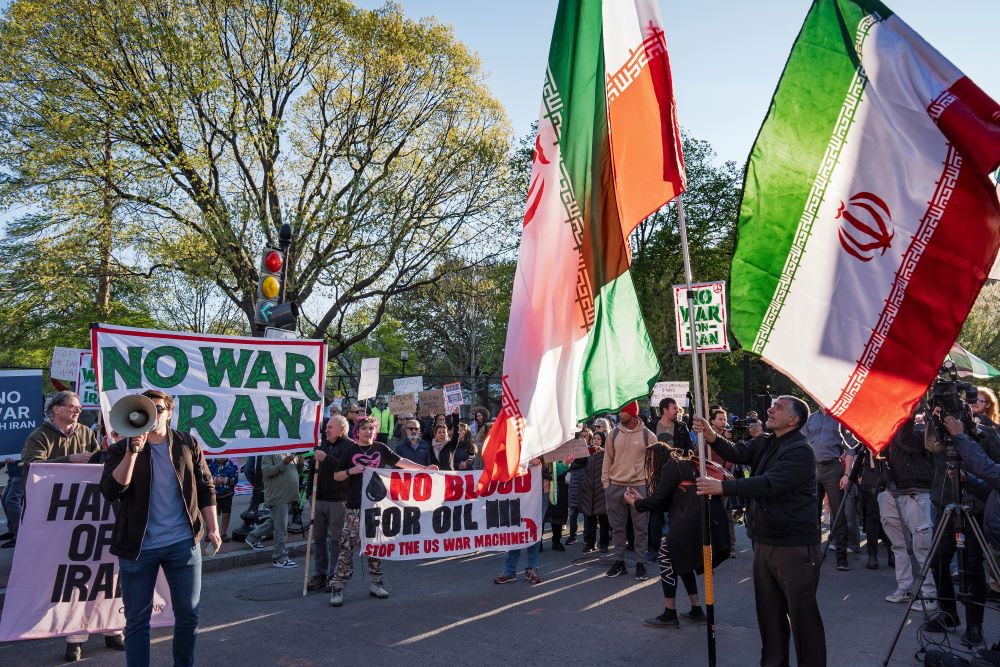
Activists protest near the White House in Washington April 7. Earlier in the day President Donald Trump had doubled down on threats to annihilate Iran. (AP/J. Scott Applewhite)
by NCR Editorial Staff
April 10, 2026
ency, an anti-Triduum that began on Easter Sunday morning. Announcing to the world that we were willing to annihilate a civilization, Donald Trump led our descent into corporate evil.
Those days and those words, fashioning an America we had not previously known, may also hold the potential for some long-term consequences that Trump could never have anticipated. Those days and words have brought us to yet another point in which we confront who we are as Americans and, more important for the Catholic community, who we are as believers.
Some indications of the answers to those questions are already in play.
In his most outrageous tirade to date, Trump managed to inspire an unlikely coalition openly opposed to his intent and to him, personally, that crossed all manner of ideological boundaries and religious divisions. In the civic sphere, former ardent supporters — members of Congress and popular online influencers — openly called for those responsible to defy his orders. Others in that quickly emerging cohort urged legislators and cabinet members to invoke the 25th Amendment or begin impeachment proceedings leading to Trump's ouster.
Those days and words represent an unsurprising result of forces intent not only on hollowing out U.S. democracy but also infusing a Christian Nationalism into the bloodstream of U.S. culture.
In the religious realm, Catholics, some of whom are deeply divided on a host of issues, joined the chorus urging military leaders and others to disobey orders that would be a clear violation of international law and Catholic just war considerations. Some even urged Trump's removal.
"Theologians, priests, academics, authors, media personalities, bishops and others took to social media platforms April 7 to warn that military strikes on civilian targets and infrastructure in Iran would constitute grave evils and violate the Catholic Church's just war tradition," reported NCR's Brian Fraga.
Whatever long-term effect that chorus of dissent might have, it is evidence that at least a moment of social sobriety is still possible.
Easter morning was the time that Trump, ignoring any meaningful reflection on the holiest feast in Christendom, chose to issue a profanity-laced intent to commit war crimes that ended with an ignorant, offensive slur of Islam.
His ultimatum: "Open the F- - -in' Strait, you crazy bastards, or you'll be living in Hell – JUST WATCH. Praise be to Allah."
On Easter Monday, he upped the ante from bridges and electrical plants. "The entire country can be taken out in one night, and that night might be tomorrow night," Trump said. He suggested that his April 7, 8 p.m. EDT, deadline was final, saying he'd already given Iran enough extensions.
That morning, the world heard the wild rantings of someone who should be nowhere near the levers of power or the potential for destruction available to the president of the United States. "A whole civilization will die tonight, never to be brought back," Trump wrote, announcing on social media his intent to order a genocide, destruction of a civilization, if his demands weren’t met by that evening.
Less than an hour and a half before the deadline, the world received a shaky two-week reprieve and Trump, accepting a "workable" 10-point peace proposal from Iran, took the first path available away from the brink to which he had so carelessly delivered himself, us and the Iranian people. Nothing of substance has been resolved in the weeks of intense bombings, which claimed the lives of thousands.
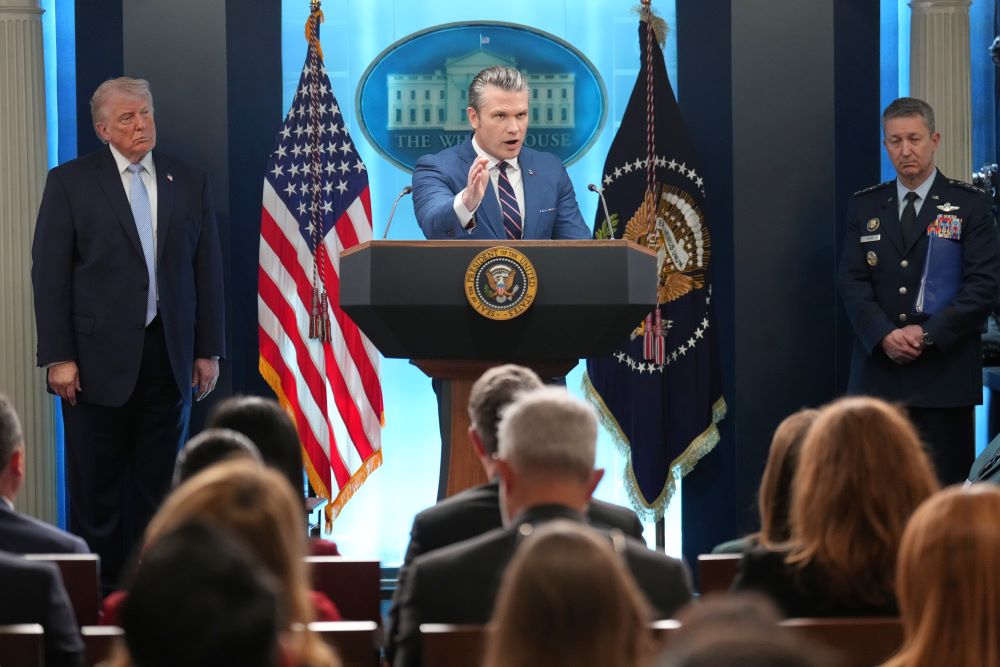
Defense Secretary Pete Hegseth speaks with reporters during a news conference with President Donald Trump and Chairman of the Joint Chiefs of Staff Gen. Dan Caine in the James Brady Press Briefing Room at the White House April 6. (AP/Mark Schiefelbein)
Those three days were perhaps the most vivid reality check Americans have yet received regarding the danger inherent in having elected such a broken, needy and amoral individual to the highest office in the land.
That three-day period was singular in the danger it posed and in the inherent betrayal of U.S. ideals it represented. Seen in a larger perspective, however, those days and words represent an unsurprising result of forces intent not only on hollowing out U.S. democracy but also infusing a Christian Nationalism into the bloodstream of U.S. culture.
The latter is most publicly represented by Defense Secretary Pete Hegseth in his preposterous invocation of the nonviolent Jesus to promote a war of choice.
The religious vulgarity of Hegseth is so undisguised and noxious that it can't be ignored. Invoking the name of Jesus to bless "death and destruction from above" was as offensive a use of Christianity's founder as one might imagine. So was his comparing the rescue on Easter Sunday of a downed pilot to the resurrection of Jesus.
Hegseth's religious peculiarities extend deep within the Pentagon, where he seeks to make U.S. militarism a campaign justified by God, and U.S. soldiers agents of God's will. Either the ambitions of this product of Princeton and Harvard grad are the result of willful ignorance or he is determined to bend U.S. history to his personal preferences. The U.S. is not a Christian nation, as he claims. It never was, not in its founding or the interpretations of the Constitution since. The United States is not a theocracy.
If U.S. Catholics were in need of clarity amid the chaos and religious jingoism, it is provided at the highest levels by a pope who speaks with a Midwest accent and thus can't be dismissed, as others have in the past, as someone who just doesn't understand the United States.
On Palm Sunday, Pope Leo proclaimed: "Brothers and sisters, this is our God: Jesus, King of Peace, who rejects war, whom no one can use to justify war. He does not listen to the prayers of those who wage war, but rejects them, saying: 'Even though you make many prayers, I will not listen: your hands are full of blood' (Is 1:15)."
He made no specific reference to an individual or country at that time, but Leo clearly condemned Trump’s later threats as "truly unacceptable" and a violation of international law.
In an interview broadcast Easter Sunday, Archbishop Timothy Broglio of the Archdiocese for Military Services, aligned himself with Pope Leo's assessment that the war in Iran was not justified by Catholic teaching.
The criticism of the Iran war is but the latest in a series of defining distinctions between the administration and Catholic leadership. From the onset of Trump's cruel plans for mass deportation, the nation's bishops have protested. They issued a statement as a body saying, "We oppose the indiscriminate mass deportation of people."
Prior to that, Cardinal Robert McElroy of Washington, celebrating a Mass on World Day for Migrants and Refugees, announced, "we are confronting — both as a nation and as a church — an unprecedented assault upon millions of immigrant men and women and families in our midst."
Other prelates led delegations to newly constructed federal detention centers, demanding that priests be allowed in to celebrate Mass. The Cardinal Archbishop of Chicago, Blase Cupich, denounced mass deportations, and he and Cardinal Joseph Tobin of Newark held special Ash Wednesday services focused on the needs of immigrants under siege.
We have noted before in this space that the U.S. hierarchy and the church at large are being drawn by dint of this administration's extreme violations of human dignity and assaults on the rule of law into a different relationship with the state than has been the case in recent history. It is a relationship no longer partisan but rather one of witness to a God of limitless love and compassion.
"The power with which Christ rose is entirely nonviolent," Pope Leo said in his Easter message. "This is the true strength that brings peace to humanity, because it fosters respectful relationships at every level: among individuals, families, social groups, and nations."
We are being summoned by circumstance and faith to a new moment and a new space in the public square. Will we be complicit in genocidal threats against otgher cultures? Will we be quiet in the face of cruelty against our immigrant neighbors?
Whether we are defined by Trump's anti-Triduum or by gross distortions of the nonviolent Christ is up to us. We can resist.
Editorial: Trump's threats force Catholics to decide if they will be complicit 🔗🔗
TRUMP HAS FAILED AS COMMANDER IN CHIEF 🔗🔗
What fighting an UNJUST WAR really means by DAVID FRENCH🔗🔗
As a Catholic my whole life, I've always been taught and always honored the pastoral leadership of the Pope. Pope John XXIII, Pope Pius VI, Pope John Paul I & John Paul II, Pope Benedict, Pope Francis , & now Pope Leo XIV.

As Isaiah 43:1 points out, the act of naming claims the one named. This “claiming” includes the recognition of a particular purpose or mission. Scripture makes this evident in the passages about God’s naming of Abraham and Israel (Gen 17:5, 32:29). When Nebuchadnezzar appointed Mattaniah as king of Judah, he changed Mattaniah’s name to Zedekiah as a sign that the new king’s authority came from the king of Babylon (2 Kings 24:17). In this same way, Jesus claims Peter and his successors to be the visible source of authority in His Church. In Matthew 16:18, Our Lord said to Simon: “And I tell you, you are Peter, and on this rock I will build my church.”
When Do We Have to Obey the Pope? 🔗🔗

How are we to explain to our teenagers, yoing adults, new Catholics when we have clergy preach from the pulpit in direct opposition to the Pope on the current US involvement and aggressor in Iran war ? I've heard it nationally and locally, the war is justified from the pulpit. And nothing happens. I cannot listen to such rhetoric.
My college education taught me about the Just War Theory, one of the most thought provoking courses I took. And I use the course material today when I converse with other Catholics.

Cardinal Joseph Tobin of Newark

Again, how can clergy, deacons, deliver a message different from the Pope & US church leadership. It's a personal message that differs from the Catholic Church. I once had a pastor , who told me he had personal political opinions or preferred candidates, and he would quietly discuss in the backroom, but never ever from the pulpit. There he is God’s voice, not a U.S. citizen. Times a changing, in a dangerous way.
Disclaimer:
This blog represents my own views, own opinions, own beliefs. They do not represent any other persons, nor organizations. If you do not want to receive blogs from me, please advise and I'll abide by your instructions. Good day.


Comments
Post a Comment